When I last wrote about exercising I found the totals quite unbelievable. I look back at those today with a smile, because the ones I now have 9 months later are even more unbelievable. So I’ll check back here in a year to see how relative this all is.
My Apple Watch is my coach
This wearable wonder of computing makes it very easy to stay on top of sports. The reminders can be annoying but useful and I noticed that I got those only when I slacked (hint, hint), which does not happen frequently. That’s how driven I am.
Monthly challenges
In 2021 I earned each of the monthly challenges, which are determined based on recent past progress and are meant to either keep you at the same level or elevate you a bit, so that at the end of the year you have improved. I wonder how big they can be after a while.
10x double move goal
180.9 km (6.5/d)
17x double move goal
30x close all rings
19x double move goals
349.5 km (11.7/d)
3695 minutes (120/d)
26700 kcal (861/d)
4220 minutes (140/d)
318.4 km (10.2/d)
27500 kcal (917/d)
4770 minutes (153/d)
Apparently there is a point after which every challenge rotates between kil(ometers), min(utes) and (k)cal.
In 2020 I earned all monthly challenges but one, which I decided not to go for (24100 kcal, or 717/d) because I knew I could not earn it even if it was the month of August.
The January 2022 challenge is to walk or run 366.7 km (11.8/d). I’m not particularly up for it but I want to do it anyway. I miss the easy challenges though.
New gear
I now rotate between 7 pairs of running shoes. I have also invested in some proper running outfits for chilly weather. It is to note that all of the sweaters I got were from the Men’s section. Not out of peculiarity but really because the colours are less flashy and the sizes fit me better because I have long arms.
My sidekick: Gizmo
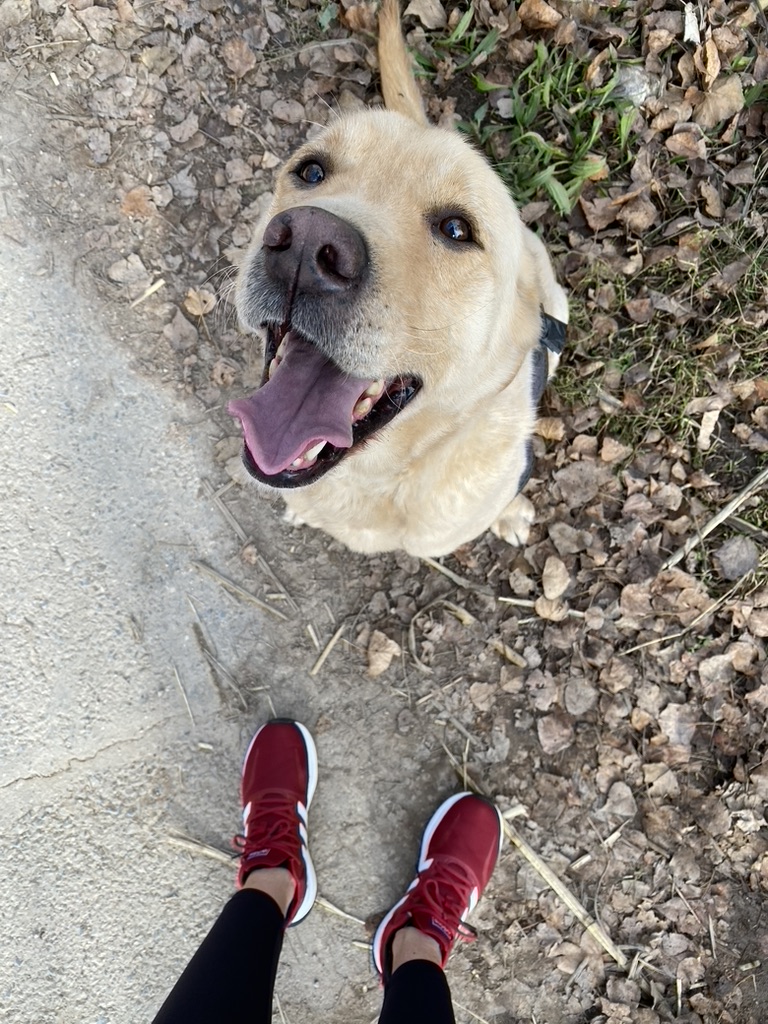
Gizmo is now 8 years old. He happily prances along and I’m very glad he’s with me. We both get our share of daily exercise, fresh air and adventures, and it gives me greater security to be accompanied by a muscular yellow Labrador. When it’s not too cold and we are next to a river he gets to swim too (but not in the sea because the sound of the ebb and flow scares him.)
Long gone are the days when he would lag at the end of the leash after running only 3 or 4 kilometers. We now go for 5K jogs once a week or twice, come back walking, and it’s perfectly fine. Or we just walk. Sometimes for two to three hours on the weekends, and on average for an hour and a half everyday.
Graphs
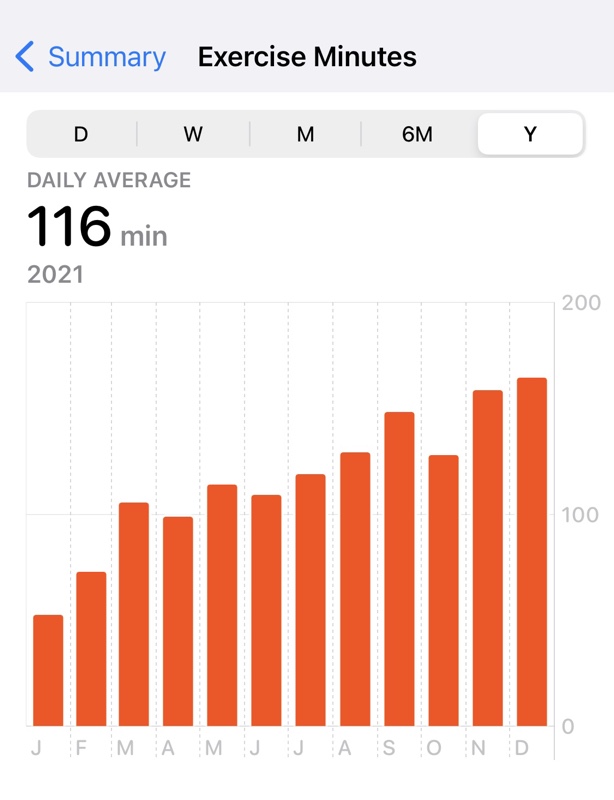
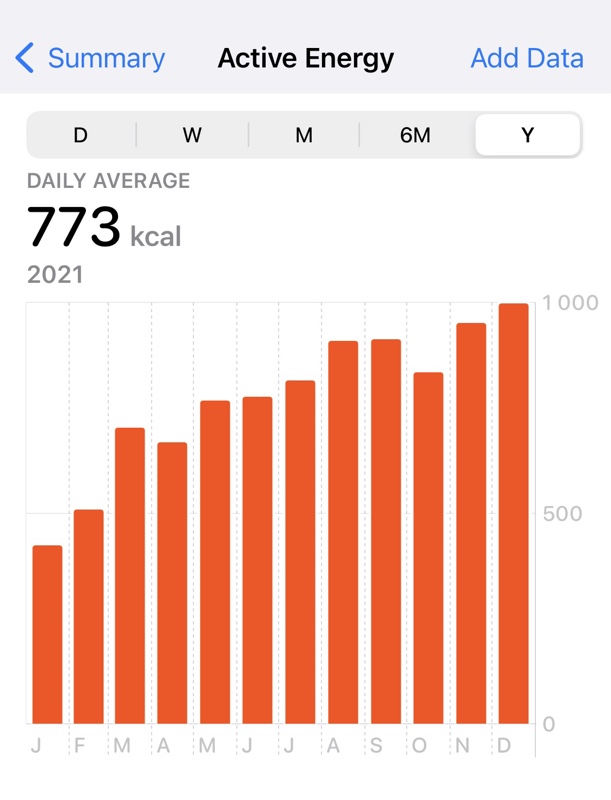
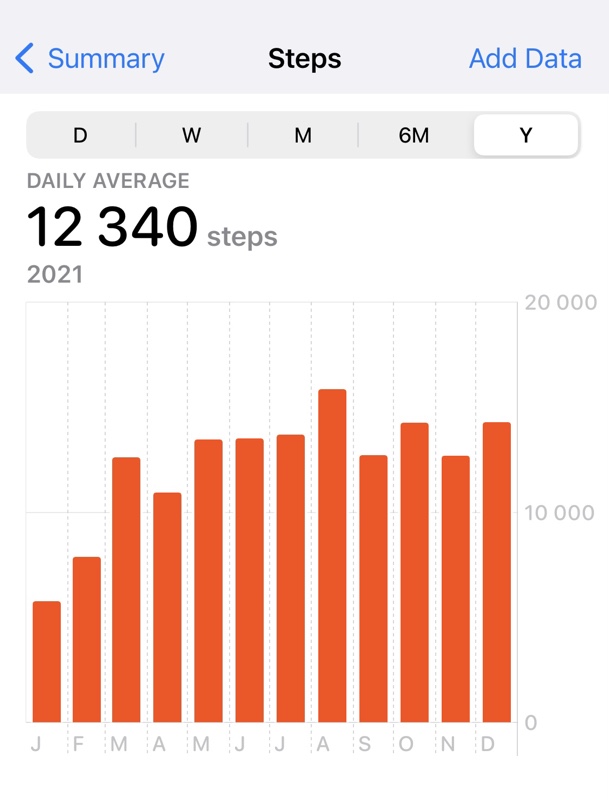
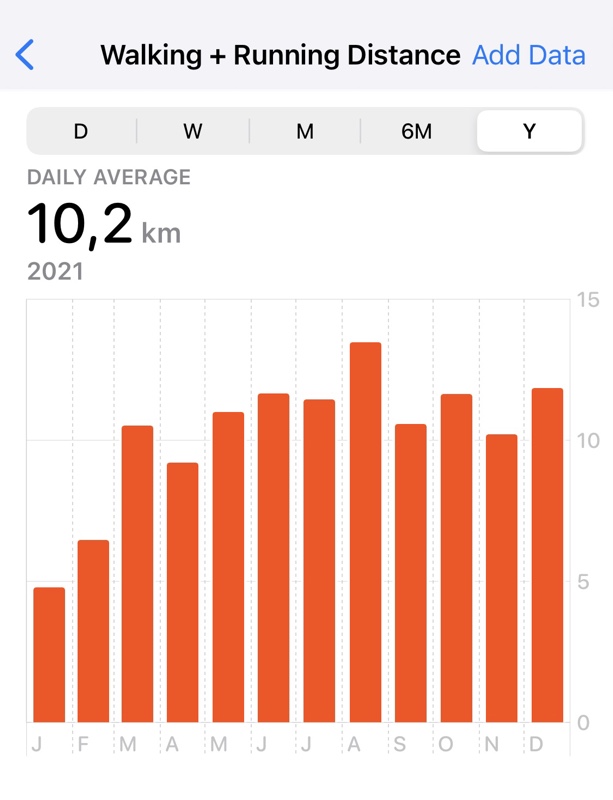
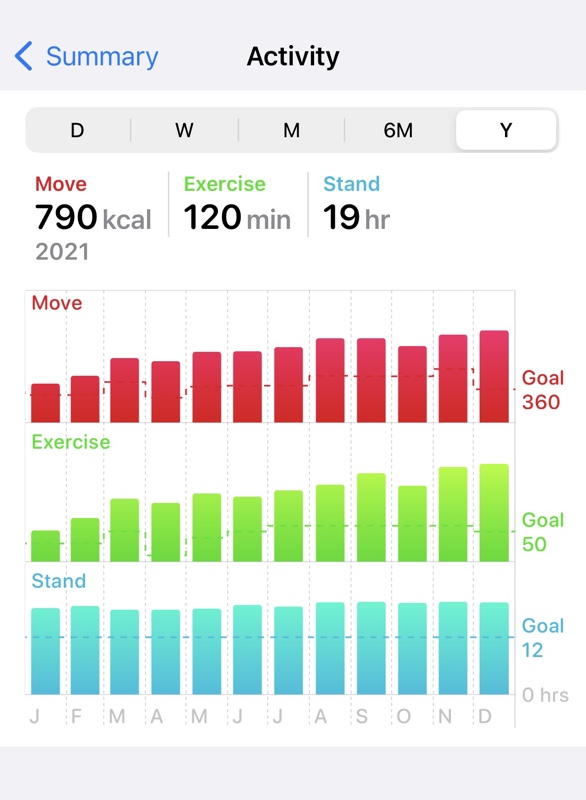
Daily average of exercise in 2021: 116 minutes (December peaked at 164 minutes per day on average)Daily average of active energy in 2021: 773 kcal (December peaked at 996 kcal per day on average)Daily average steps in 2021: 12340 (August peaked at 15859 steps per day on average)Daily average running and walking distance in 2021: 10.2 km (August peaked at 13.4 km per day on average)Activity graphs in 2021: move, exercise (both going up), stand (steady at 19)Tallies of fitness and exercising metrics for the year 2021
Notes on the graphs
According to those tallies (generated by the excellent and free Fitness Stats iPhone app), my 2021 in sport can be broken down as follows:
711 hours of exercise (= 29.6 days, so a twelfth of the year)
3746 kilometers walked/run (whereas I drove a bit over 5000 km with my car)
… of which I ran 226 (average of 4K every week)
103 hours on the elliptical (this is equivalent to watching 123 typical TV series episodes, and guess what: that’s exactly what I did while on the elliptical)
650 workouts (on average I did almost two different activities everyday)
From an addiction to another
2021 is when I stopped smoking. I made up my mind in January or February and my strategy was to ramp up exercising, pick up an electronic cigarette, gauge if that was going to work, and carry on with the routine without smoking. That happened in May. I have not smoked since then. Woohoo!
But ramping up exercising meant that I burned more calories and therefore needed to up my food intake. Stopping smoking made me more hungry too, so I had two reasons to eat bigger portions.
I remember starting to eat as much and then a little more than my teenage boy! (Who abandoned basketball during the first year of the pandemic, and now more or less refuses to walk or hike with me even every now and then.)
I gained a lot of muscles apparently
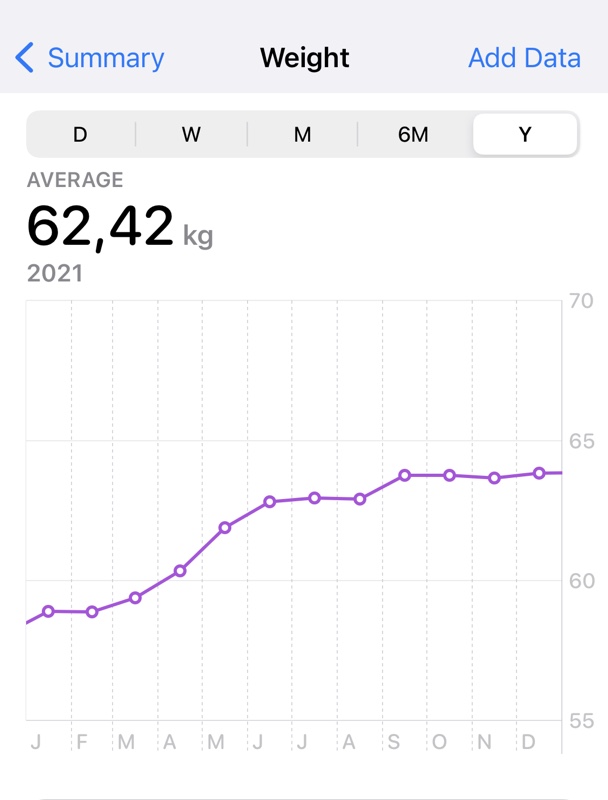
I was a bit dismayed when I saw my weight ramp up slowly but very very steadily. It has now stabilized after 8 months or so, sometime in September.
However, my clothes continue to fit me so that means that I lost fat and gained (6 kilos of) muscles.
Weight graph for 2021: 62.42 kg on average (current trend is 63-64 kg)
Strava’s year in sport
One of the perks of being a paying subscriber of the sports tracking app Strava is the yearly report. See below.
Aside: I used to complain a lot about how that app was geared towards triathletes only. They fixed almost all the things I complained about and now it celebrates and motivates every kind of athletes, not just those who cycle, run and swim.
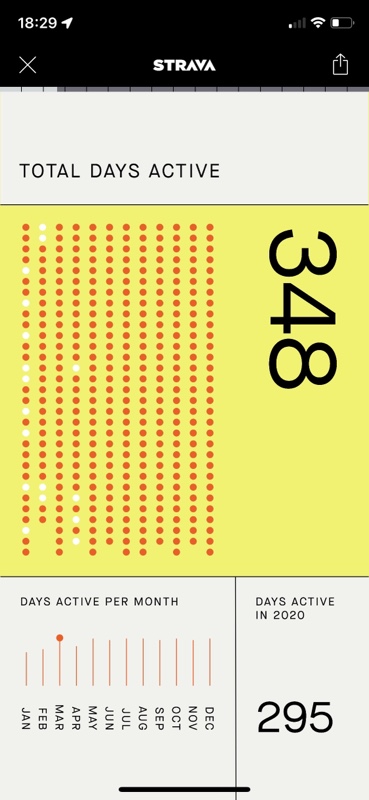
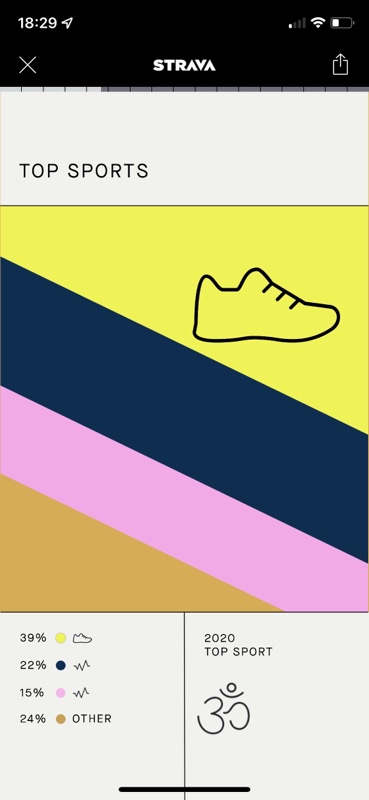
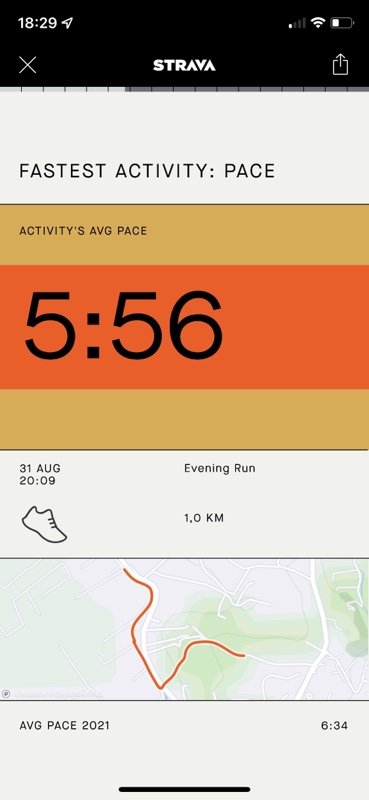
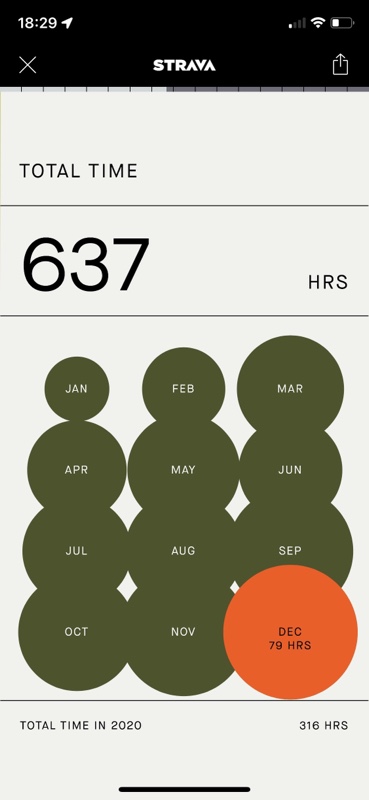
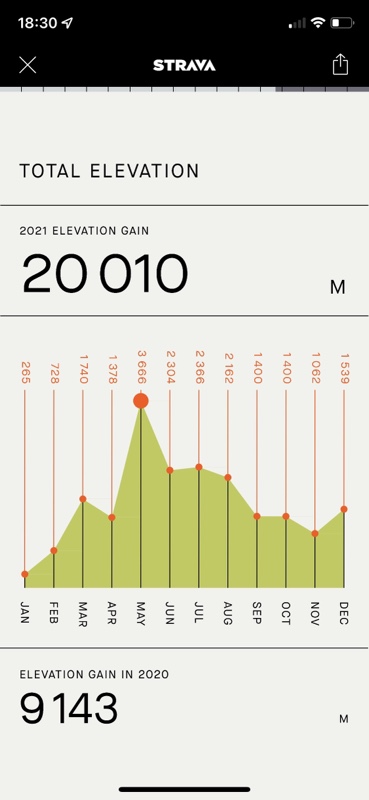
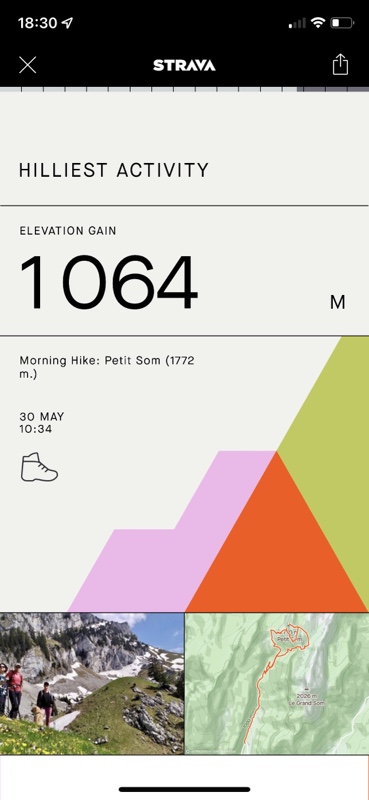
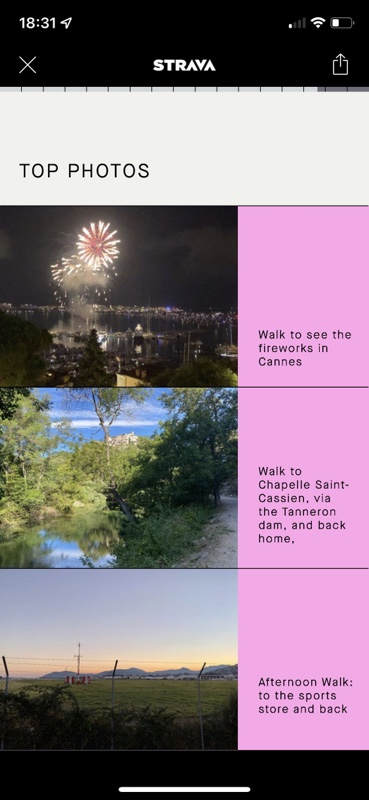
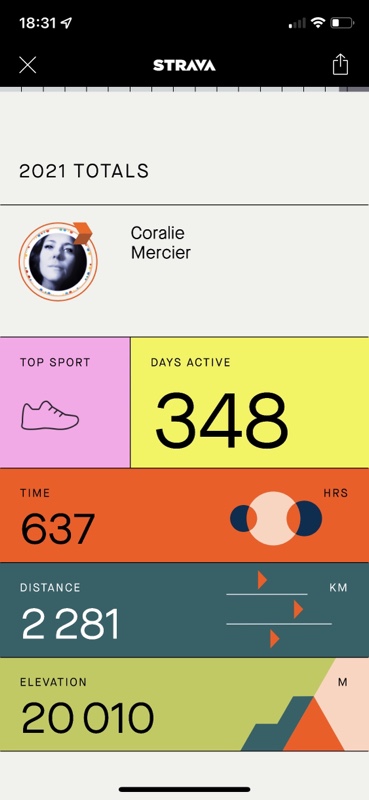
Cover of the report348 days activeLongest streak: 245 days between May 1 -December 31Top sports visualization (walking at 39% is top)Fastest running pace: 5:56Total time: 637 hoursTotal distance: 2281 kmLongest activity: 31 kmTotal elevation: 20010 mHilliest activity: 1064 mTop photos: fireworks, Auribeau, Mandelieu airportSummary cover
I want to celebrate because it’s a big deal for me. I want to at least mark the occasion, leave some breadcrumbs for curious future me, or —who knows?— for curious wannabe-non-smokers!
Since it’s a very different journey for everyone I can’t claim that my experience will work for others. But here are some takeaways and the things that made a big impression on me.
Framing your mind
Wanting is the first requirement, but may be insufficient (it’s my 3rd try and each attempt was more in earnest every time, in hindsight —i.e., each *seemed* 100% serious, and yet…)
Plan intelligently: set yourself up for success (I was fortunate to be able to time this with nearly a full month off work, and since work-induced stress or frustration ARE among my triggers, I chose thus to make the most of that vacation.)
Know your triggers and know that there will be a hard few weeks (as little as one, no more than three —the time it takes the nicotine to entirely leave your body—, and it gets better: the difficulty decreases steadily, it does not plateau.)
Know that cravings last only a handful of seconds. You can resist them even if they are potent and numerous. (You’ll get a lot of them at first, then fewer and fewer, and after 3 or 4 weeks they’re going to be anecdotal.)
Because for many people the monetary commitment is a necessary step, purchase something like nicotine gums or patches, or an electronic cigarette with nicotine or no nicotine fluids, or Allen Carr’s “Easy Way to Stop Smoking” (or all of the above!) My friend Amy gave me the latter 13 years ago (more about it further down), I got gums and patches 3 years ago, and this time I bought a couple electronic cigarettes in February because they were on sale.
Do not trust yourself with emergency cigarettes or tobacco nearby “just in case”. Don’t. Really, just don’t. Since you’re choosing to become a non-smoker, choose whether you finish your current supply or dispose of it, turn the page and start anew!
Last, but not least—Adopt constructive language and thoughts: you ain’t giving up smoking, you choose to become a non-smoker —you are becoming a new version of yourself (the problem with “giving up” is that at core it is a deprivation, the problem with “stopping” is that it signals negative behaviour, and the problem with “quitting” is the implied notion of failure.)
There is no doubt whatsoever that for the first several days (or weeks) not smoking is a deprivation, and you are the first to know that smoking is negative behaviour, and you will be tempted to fail by giving in. You know all that perfectly well, so it’s beyond the point to further the negativity and all to your credit, and your mental sanity, to think positively: you catch more flies with honey than with vinegar. Let this constructive language and thinking be your honey.
Look at yourself squarely in the eye
For me, it was the realisation during a particularly long trip that eagerly awaiting layovers and thinking “at long last I’ll be free to smoke [albeit in a horribly crowded and smelly place]” was in fact THE OPPOSITE of freedom. It was SLAVERY.
Once I had discovered this, it was a matter of time before I could do the right thing, but there was in no case any forgetting the discovery.
Allen Carr’s “Easy Way to Stop Smoking”
It’s a great book! I have not finished the book, however. I picked it up exactly three times in the 10+ years it’s been in my possession, and could never finish it. The second time, I didn’t even open it. The third time I went further than the first and I dare say I read enough for it to work.
It’s absolutely tedious prose. But the text is very simple and very, very repetitive.
Its purpose is to get you to acknowledge that since you became a smoker you have convinced yourself that you love it and depend on it.
“I think the most pathetic aspect about smoking is that the enjoyment that the smoker gets from cigarette is the pleasure of trying to get back to the state of peace, tranquility, and confidence that his body had before he became hooked in the first place.”
Allen Carr, “The Easy Way to Stop Smoking”
I stopped after the first third which is the important part where I got it into my head that THERE IS NOTHING TO GIVE UP.
I think of myself now as a different version of me.
Three years ago I failed because I was dominated by the notion that I would have nothing to replace smoking with. This time I understood that “nothing” is what you replace it with. In fact “freedom” is what you replace “slavery” with. WIN!
Self-hypnosis and other TEDx pep talks may work too!
I relied early in the journey (in the first two weeks) on listening to a 50-minute self-hypnosis recording by Michael Sealey, (bonus points for his charming Australian accent and deep soothing voice) based on some measure of neuro-linguistic programming (at heart it’s programming yourself by visualising what you want, while in a conducive state of relaxation), and a short TEDx talk by Nasia Davos, an eloquent Greek lady that I felt like I knew, after listening to her two or three times, whose main message is: every time you crave the cigarette, substitute “smoking” by “air” or “water”.
I feel confident
Third time is the charm? Maybe. Along the way there have been signs I have “bookmarked” such as the guilt I felt while not being entirely able/willing to stop smoking while pregnant 14 years ago, my former mother in law —a heavy smoker, like me— who succumbed to cancer a few years ago, my son asking me to stop, my parents and brother years before him, etc.
This time has been and felt different from previous attempts. I may simply have been ripe for it. Or picking up exercising 15 months ago set myself up for that particular success.
It’s been over a month and I feel pretty good about it. My family, friends and colleagues have been extremely supportive of me (love y’all!). I have become slightly more efficient in my exercising; I have even started again to run and I am still not great at it but way better than last year.
I feel confidence that I am a non smoker, at last.
Cet article est dédié à Sophie, qui n’en est pas à son premier défi. Loin de là. You got this, sister!
« Vouloir c’est pouvoir. » [Mais oui, bien sûr… songeais-je en avec un plissement d’yeux et haussement de sourcils]
Ce que je veux dire c’est que la volonté est un moteur puissant. Quand ça ne fait pas tout, il faut s’aider. Tout ce qui suit représente de mon point de vue les ingrédients qui ont fait de moi une adepte de l’exercice.
Je veux faire de l’exercice !
Super ! Non seulement c’est très tendance depuis début 2020 en particulier (merci la pandémie planétaire de Covid-19 –lire l’article du Point décrivant les modifications et la hausse de nos activités sportives) mais c’est également excellent pour la tête et pour le corps. Anima sana in corpore sano (oui, oui, c’est ce que veut dire Asics, la marque de chaussures de sport.)
Une âme saine dans un corps sain
J’adhère complètement. En ce qui me concerne, je dirais plutôt : un corps sain qui permet à l’âme de se tranquilliser, s’épanouir et s’illuminer.
Ce fut pour moi une bonne surprise. L’effet de bord que je n’attendais pas. En effet, je me suis convertie sur le tard, adoptant assez spontanément l’exercice dans le cadre de ma crise de la quarantaine, un peu comme une résolution du nouvel an, mais en mars. En seulement trois semaines j’ai constaté avec effarement ses bienfaits sur mes genoux et mes hanches. Après six semaines, je suis passée de “angoisse, stress, fatigue, insomnies, démotivation et manque d’entrain” à “Je me sens bien, assez souvent. J’ai trouvé un bon équilibre entre sommeil-travail-exercice-être mère. Je dors mieux et beaucoup.”
Sans même exagérer, j’affirme que c’était miraculeux. Pour être claire, à 44 ans je suis passée du jour au lendemain de zéro activité physique toute ma vie d’adulte à la pratique quotidienne du sport. Ça fait plus d’un an et c’est pas près de changer.
Qu’est-ce que ça m’apporte ?
J’ai fait le point de ce que ça m’apporte, et j’ai bon espoir que ça soit probablement applicable à tout un chacun.
Harmonie : s’octroyer du temps pour soi pour trouver un équilibre harmonieux entre ce qu’on doit faire et comment s’en récompenser.
Bien-être : le corps sécrète des endorphines lors de l’activité physique qui ont un effet analgésique et procurent une sensation de bien-être, voire de joie. Leur fonction est d’inhiber la transmission des signaux de la douleur en bloquant un neurotransmetteur qui, une fois bloqué augmente la production de dopamine, qui est le neurotransmetteur associé au plaisir. Autrement dit, le sport c’est de la drogue dopante et c’est 100% légal. CQFD.
Fierté : observer ses propres progrès et s’en réjouir à juste titre.
Gratification : véritable accélérateur d’estime de soi, se découvrir capable de franchir ses limites et récolter les bénéfices de les dépasser – se dépasser.
Remède : car le sport permet de gainer ses muscles et renforcer ses articulations ce qui est source naturelle de guérison de certaines douleurs de posture, ou liées à des limites de mobilité.
Cercle vertueux : la discipline nécessaire à adopter l’exercice s’inscrit de manière organique dans un mode de vie plus sain.
Intérêt : il y a non seulement une variété d’exercices physiques qui rend cela intéressant, mais aussi c’est un moyen de changer ses perspectives, faire des rencontres peut-être, observer, découvrir. En d’autres termes : s’enrichir.
Et finalement : une meilleure santé. Un meilleur rendement cardiaque, plus d’endurance, un sommeil meilleur, et éventuellement une perte de poids. Pour cette dernière, attention –il faut un engagement réel et beaucoup, beaucoup de ténacité. Car on gagne du poids largement plus et plus vite qu’on en perd.
À quelle dose ?
Il y a une raison justifiant que sur l’Apple Watch la durée par défaut du cercle “m’entraîner” soit de trente minutes. C’est par la pratique régulière d’activité physique d’au moins 30 minutes par jour, à un rythme soutenu, que le corps fabrique des endorphines. Ce n’est pas un but en soi, certes, mais ça aide à rentrer dans la routine et y rester.
Trente minutes c’est également un temps suffisamment court et suffisamment long pour accroître les chances de faire l’effort de le caser dans sa journée.
L’important c’est de se mettre dans une position de succès. Tout ce qui va faciliter la mise en place et la pratique régulière est bon à prendre. Si trente minutes seront une frein, tabler sur quinze !
Les chances sont grandes que ce temps de base se trouve en hausse rapidement. En ce qui me concerne mon premier mois a vu un temps moyen quotidien de 40 minutes, le suivant de 60 minutes, puis 80, etc. Un an après j’en suis à 110 minutes en moyenne.
Quand puis-je commencer ?
Immédiatement ! Il n’y a pas une seconde à perdre.
Tout ce qu’il faut c’est un coup de pouce
L’instrument de ce succès ? La montre connectée. Bien qu’il m’ait fallu sept mois pour considérer la mienne telle qu’elle est, mieux vaut tard que jamais : mon Apple Watch est un coach, un chronomètre, une télécommande à musique ou livre audio, qui n’attend qu’un coup de pouce (je veux dire le toucher léger d’un doigt, évidemment) pour déclencher l’enregistrement d’activités et se transformer en accompagnateur de développement personnel physique (utiliser l’app Activité sur l’Apple Watch).
L’Apple Watch couplée à l’application Santé disponible dans iOS, c’est tout ce qu’il faut pour s’y mettre.
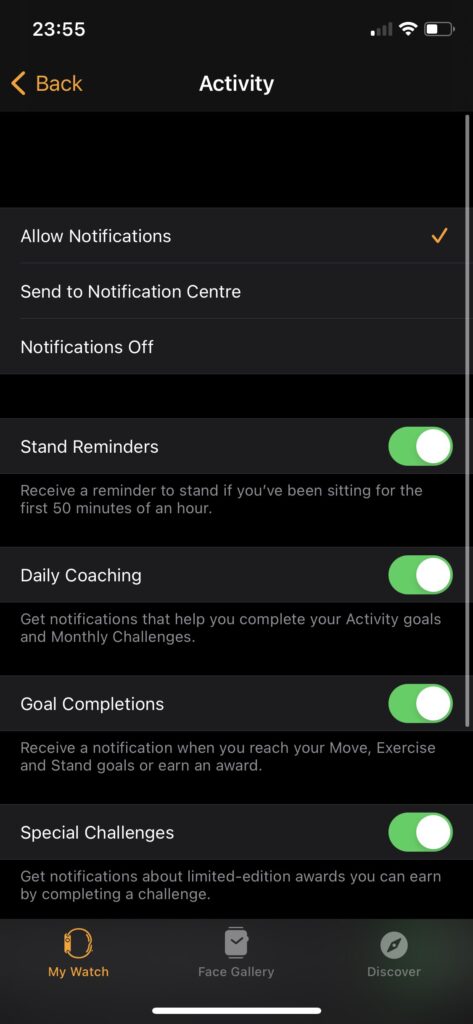
Dans les paramètres de la montre sur l’iPhone, commencer par cocher TOUTES les options possibles dans “Activité”.
C’est ça qui fait de la montre connectée un coach sportif qui va envoyer une petite impulsion au poignet pour signaler qu’il est temps de se lever et marcher une minute, qu’il va y avoir un challenge exceptionnel, qui félicite d’avoir atteint un objectif, etc.
Elle propose de capitaliser sur les efforts déjà fournis pour leur donner tout leur sens.
Je ne cache pas que parfois c’est pas le bon moment et ça peut être agaçant 😁 et il faut donc bien se rappeler qu’il s’agit d’un programme et que nuire et taquiner ne fait pas partie des intentions de ce programme.
Un type de cadran efficace pour accompagner la démarche
L’Apple Watch présente l’avantage de stocker une quantité de cadrans personnalisés adaptés à toute envie, toute situation.
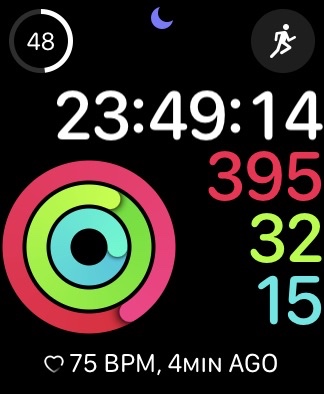
Parmi les cadrans spécifiques aux activités sportives, j’ai choisi celui-ci car l’heure et la visualisation des cercles et leur quantification numérique sont l’information principale. Autour, j’ai disposé :
Indicateur de batterie
Rythme cardiaque
Raccourci pour démarrer une activité
Il y a plusieurs options déjà disponibles dans la galerie de cadrans et toutes sont personnalisables.
Quel programme ?
La question est en fait quels programmes, au pluriel. Parce que le but est d’assurer sa propre réussite, il faut dès lors se faire plaisir. Et parce que l’on se lasse de certaines choses inévitablement, il faut varier les plaisirs.
Expérimenter d’autres types de sports permet non seulement de s’adonner à celui qui est le sien (on a tous un sport de prédilection –et c’est pas forcément celui qui nous sied le mieux), de s’en approprier d’autres, mais aussi de pérenniser la pratique physique.
Il faut s’appuyer sur ses intérêts et habitudes existants, car : routines facilitées = dispositions optimales. Par exemple :
J’aime faire du vélo et je dois aller à la poste ou faire deux courses 👉 j’enregistre mon trajet avec l’Apple Watch car oui, ça compte !
J’aime écouter de la musique ou des livres audio, je dois promener molosse et j’aime prendre des photos de la nature 👉 ces ingrédients sont compatibles avec la marche à pied, le jogging.
J’aime regarder des séries ou des films et je veux faire du sport 👉 ces ingrédients sont compatibles avec le vélo d’appartement ou elliptique installé devant un iPad ou la télé/l’ordi.
J’aime faire une pause détente dans ma journée, ou créer un avant-travail ou passer du travail à autre chose, ou encore me relaxer avant d’aller dormir 👉 ces ingrédients sont propices à une séance de yoga en suivant les mouvements d’une Youtubeuse yogi favorite.
Il s’agit donc de trouver quels arrangements faire aux routines établies pour se donner le plus de chances d’intégrer l’exercice dans sa vie.
Et si pour ça il faut dépenser un peu d’argent, il ne faut pas hésiter. Que ce soit s’équiper de nouvelles chaussures pour démarrer du bon pied (ha-ha), d’un nouveau gilet pensé exactement pour le type d’activité cible pour ne pas pouvoir prétexter afin de ne pas y aller qu’il fait trop frais ou qu’on manque de poches, ou bien qu’il s’agisse de souscrire à un service payant via une app pour se donner encore plus de chances d’y arriver.
Pour aller plus loin, voici une description de deux applications de suivi sportif, qui sont également des réseaux sociaux (notion d’amis, ajout de photos, partager), que j’utilise :
SportsTracker
SportsTracker est un service totalement gratuit. Il me semble qu’il est édité par Amer Sport, la société mère (adoptive) de Salomon chez qui j’achète religieusement des chaussures de sport depuis le début des années 2000 (à l’origine par goût vestimentaire et désormais par élitisme sportif)
App et service en ligne. On me l’a recommandé récemment alors que je me plaignais du concurrent (voir ci-dessous). J’adore ❤️
Intégration parfaite avec l’Apple Watch (ou autre appareil connecté), ce qui fait que chaque activité s’importe automatiquement et les graphes sont générés à la volée.
L’application fait une utilisation géniale des cartes, avec des masques différents. Elle permet de faire ses itinéraires, d’en découvrir des existants, d’en trouver des populaires par type d’activité et par endroit.
Via l’analyse, on peut retracer toute une activité sur la carte et découvrir pas à pas sa vitesse, son rythme cardiaque, l’altitude.
Quand on ajoute des photos à son activité, l’application permet de choisir parmi les photos prises durant l’activité.
L’analyse par activité comprend également une estimation du temps de repos recommandé.
C’est mon coup de cœur, même si elle n’intègre pas de challenges, ni de suivi de son matériel.
Strava
Strava est le service de prédilection des triathlètes. App et service en ligne. Comme SportsTracker on peut démarrer une activité via l’app ou laisser l’Apple Watch tout enregistrer et ensuite importer l’activité dans l’app, dont il existe une version gratuite.
Malheureusement, fin 2020 une grosse partie des fonctionnalités ont été basculées dans la partie payante. Je suis cliente payante depuis un an et j’aime beaucoup leurs graphes et visualisations. Notamment l’indicateur de fitness cumulé qui se base sur l’indice d’effort relatif (lui-même calculé à partir des mesures du rythme cardiaque et disponible dans chaque activité enregistrée), qui est un concept qui est propre à Strava.
Il me semble que les challenges ne sont pas réservés aux membres. Ils sont un bon moyen de se dépasser, par exemple. Tout challenge accompli (à noter qu’on peut quitter un challenge à tout moment) donne l’obtention d’un trophée qui apparaît dans son profil.
Un autre aspect est spécifique à Strava : l’enregistrement de matériel tel que vélos ou baskets ce qui permet d’avoir une idée de ses préférences d’utilisation, de l’usure, mais aussi de se faire prévenir passée une certain « kilométrage ».
À vos marques !
Alors, on fait ami-ami sur SportsTracker et on se soutient mutuellement dans notre quête de bien-être et d’équilibre ?
2022-08-03 Update: reflected that the transition to a legal entity was postponed by a year; gave link to media advisory of that transition; rewrote two phrases.
Abstract of what is on my mind: work is transactional by nature, excellent connections with coworkers are precious (I am fortunate to have many). Now, the companies that consider their work force “family” puzzle me. This is not exactly the case where I work (or is it?), BUT we are in a setting that is pretty conducive to it, AND after 27 years, this is going to change –in less than a year two years. SO I really wonder what that change will do to the current equilibrium (I’m pretty sure it’s going to put it to the test).
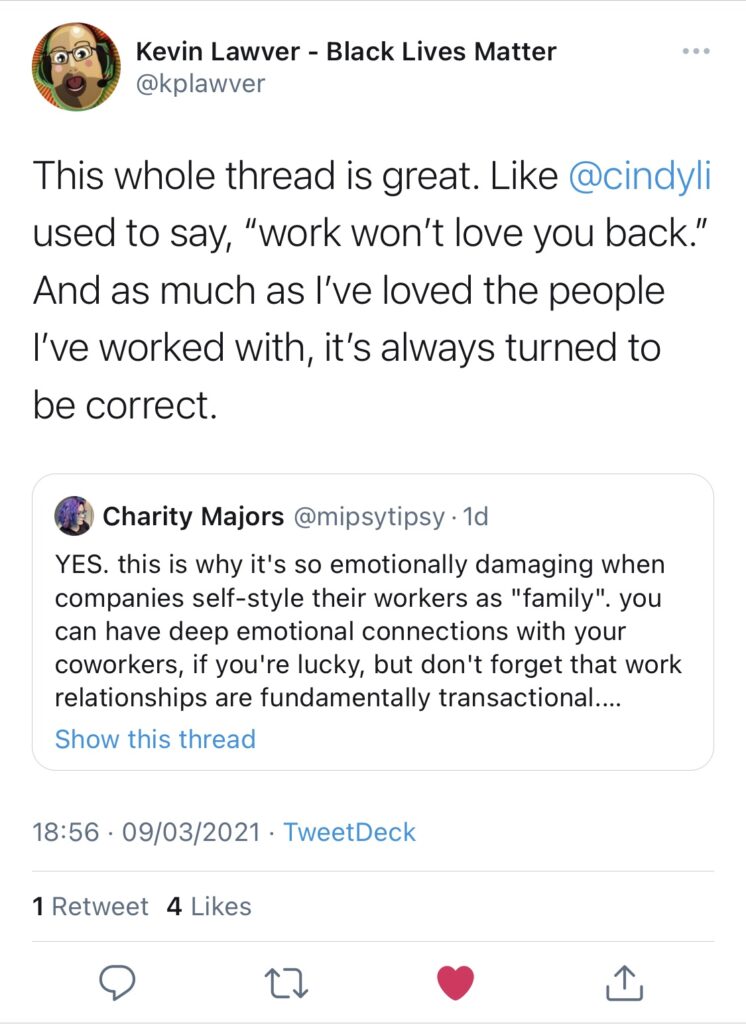
This stemmed from my browsing The Twitters yesterday. I read Kevin‘s tweet.
He wrote ““work won’t love you back.” And as much as I’ve loved the people I’ve worked with, it’s always turned to be correct.“
Kevin was quoting another Twitter thread where I read “it’s so emotionally damaging when companies self-style their workers as ‘family’. you can have deep emotional connections with your coworkers, if you’re lucky, but don’t forget that work relationships are fundamentally transactional. i hope your family is not.“
I don’t consider my workplace to be like family and we aren’t self-styled as such either. But, work is very central in my life: every other week I spend most of my waking time at work (the other week, I am solo parent of a teenager, spending just normal amounts of time at work).
Firstly, I am fortunate to have very deep emotional connections with many of my coworkers, a few of which I even regard as father parent figures, many of which are true models for me, most of which I respect tremendously.
Secondly, we have very little turnover. I’ve worked there for over 22 years and many current colleagues were already in the team when I joined. And we welcome newcomers, not as siblings, but with similar care and attention to their success. As though we have a stake in it –and we do, yes.
Thirdly, we get together (we used to, pre-COVID at least) every now and then and those occasions are always enjoyable and looked forward to by most. Yes, like any other workplaces, there are difficult people who get along with fewer people, or are not interested in making any connections at all. That’s my description of our unusual work environment. In fact, I remember how I described it to my mum a few years into it: it’s like summer camp where you make new great friends and do exciting stuff, but it’s all year-round.
Now, our administrative setup allows us to do our work without a whole lot of competition, without too many frustrations, because we are employed by four different institutions that legally “host” our consortium, and in most of our cases, the people who employ us are not those we take work orders from. I think that makes a world of a difference.
Change is coming. The Hosts arrangement, in place from the start in 1994, has enough drawbacks that for a few years now we have been exploring how to become our own legal entity. This is set to happen on January 1, 2022 2023. When it does, the consortium will have its own bank account, legal and fiduciary obligations, and traditional management powers that we currently do not fully have.
The dynamics are bound to change. While today I (and many others in the team) are moved by the sheer impact our work has on society (HTML –heard of it? CSS, Web accessibility, Internationalization, etc. We are the little known consortium that makes the Web work, for everyone) and the Hosts that employ us provide the best abstraction to shield us from the reality of the transactional nature of work, this is going has the potential to hit us in the face like the train crashing Dr. Woodward’s truck in the movie Super 8!
There is a lot on our plates and most of us overwork because it’s really worth it! I remind myself on occasion that work won’t love me back, but once we are truly as valuable as our ability to make the company money, I wonder how the care will fare.